Being offered a graduate assistantship answers an important question about work or support. It does not, by itself, answer every question about tuition benefit participation. The distinction matters because the appointment and the benefit can involve related information while still requiring separate verification. A job title should not become a shortcut around the actual eligibility conditions.
This independent University of Utah guide helps organize those questions. It is not employment advice, financial advice or a benefit determination. Your written appointment materials, home department and current Graduate School guidance are the relevant authorities. We do not review personal offers, collect records or act as a tuition benefit coordinator.
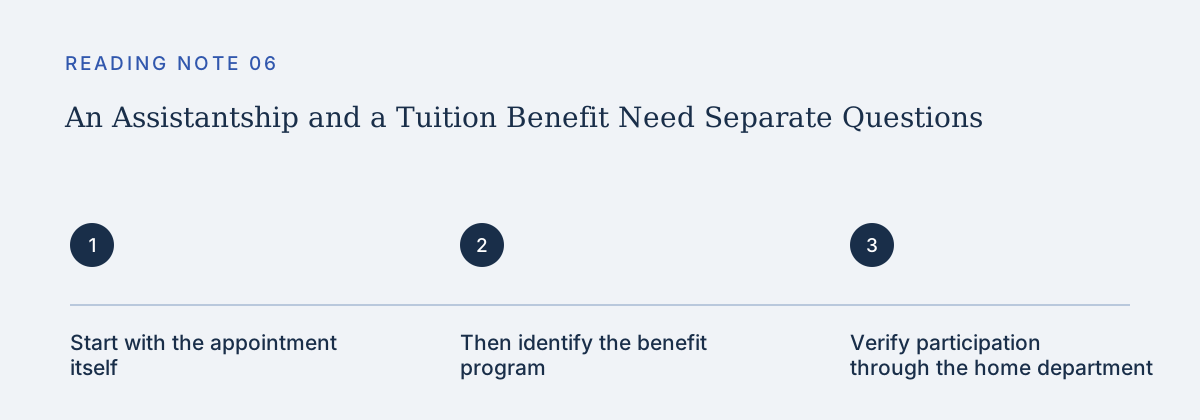
Start with the appointment itself
Read the appointment materials for the work period, responsibilities, supervisor and stated conditions. Identify anything that remains unclear before relying on an informal description of the role. A research project may continue across several terms while a particular appointment covers a narrower period. The dates in the actual offer matter more than a broad description of the lab's plans.
Ask whom to contact about duties and appointment administration. That person may not be the same person who handles tuition benefit participation. Keeping the roles distinct helps you ask the right question without expecting one conversation to resolve every part of graduate support.
If your responsibilities change, seek clarification about the appointment rather than assuming the original terms automatically extend to new duties. Preserve the written explanation with the relevant offer. The goal is to understand the agreed arrangement, not to create an independent interpretation of employment policy.
Then identify the benefit program
The Graduate School's TBP FAQ lists qualifying support categories and states that all eligibility requirements must be satisfied. Its guidelines describe additional participation conditions and distinguish TBP benefits from the benefits administered for full-time, benefited university employees. Do not apply a general employee-benefits page to a graduate tuition question without verifying that it concerns the same arrangement.
Ask whether your particular appointment is associated with TBP, whether your degree route is eligible and which term is under review. If the answer refers to a different funding mechanism, request the appropriate official information for that mechanism instead of forcing it into the TBP model. Graduate support can be described accurately without assuming that every arrangement works the same way.
Verify participation through the home department
The TBP FAQ identifies the departmental coordinator or director of graduate studies as the place to verify eligibility and departmental list participation. It also explains that students supported by another department are listed through their home degree department. This is a useful distinction when the person paying for the work is not the person administering your graduate program.
When two departments are involved, ask who needs to coordinate the information. Provide the term and appointment context, but avoid sending sensitive documents to a broad group of recipients merely because several units are connected to the arrangement. Let the official contacts specify what information they require and how to provide it.
A practical question is: “My degree program is here and my support comes from another unit. Who should confirm my tuition benefit participation for this term?” That wording identifies the relationship without assuming there is an error or asking one department to make a decision outside its role.
Ask about enrollment before changing it
Academic registration, appointment expectations and tuition benefit requirements can place different conditions on a student's schedule. Do not treat the minimum needed for one purpose as proof that the schedule is acceptable for every purpose. Ask about the actual planned enrollment before dropping, adding or substituting work in a way that could affect participation.
Describe the proposed change in concrete terms and ask which current requirement should be checked. A vague question such as “Will I still be full time?” may not reveal that you also need to understand benefit coverage or the treatment of a particular course. Keep these questions distinct even if the same coordinator helps you route them.
This article does not recommend a credit load or tell you how to preserve eligibility. The appropriate answer depends on the current rules and your circumstances. An official explanation of your plan is more valuable than a generic number copied from a peer's schedule.
Do not treat a visible benefit as permanent clearance
The university's TBP important-dates guidance describes reconciliation and warns that unmet conditions can lead to a benefit reduction or removal. Review any official notices and respond through the specified university route. An earlier account entry is useful evidence of what was posted, not a guarantee that no later review can change it.
Similarly, a missing entry deserves a specific inquiry rather than repeated assumptions about timing. Ask whether there is an action for you, the department or another office. If the question overlaps with a billing deadline, bring that urgency to the appropriate official contact. This publication cannot grant an extension or instruct you to ignore a charge.
A fictional cross-department appointment
Suppose Priya studies in one department and receives a research appointment in another. She confirms the work expectations with the hiring unit and asks her home department about the tuition benefit record for the same term. These are complementary conversations. Neither becomes redundant simply because both relate to the same research work.
Priya keeps a short note identifying the confirmed appointment, the benefit question and the next requested action. She does not conclude that a paid appointment automatically means every charge will be covered. This fictional example illustrates coordination, not an actual student's outcome or a guarantee of eligibility.
A useful closing checklist
Before treating the arrangement as understood, make sure you can identify the appointment period, the person responsible for work questions, the applicable tuition support mechanism and the official contact for participation questions. Keep any unresolved condition explicit. Clear separation makes it easier to spot a missing step without turning ordinary uncertainty into an unsupported promise or alarm.
Official references and next reading
Tuition Benefit Program FAQ (official University source)
Tuition Benefit Program Guidelines (official University source)
Tuition Benefit Program Important Dates (official University source)