A graduate funding offer can sound comprehensive while leaving several practical questions to be answered. It may describe an appointment, a fellowship, tuition support or a combination of arrangements. Your student account, meanwhile, shows charges and entries for a particular period. Neither document should be stretched beyond what it actually establishes.
This article is an organizational guide, not financial advice or an interpretation of your contract. It does not estimate what you owe or promise that support will cover a particular charge. At the University of Utah, use the written offer, current program guidance and the responsible official offices to clarify your own arrangement. Do not share your offer or account records with this independent publication.
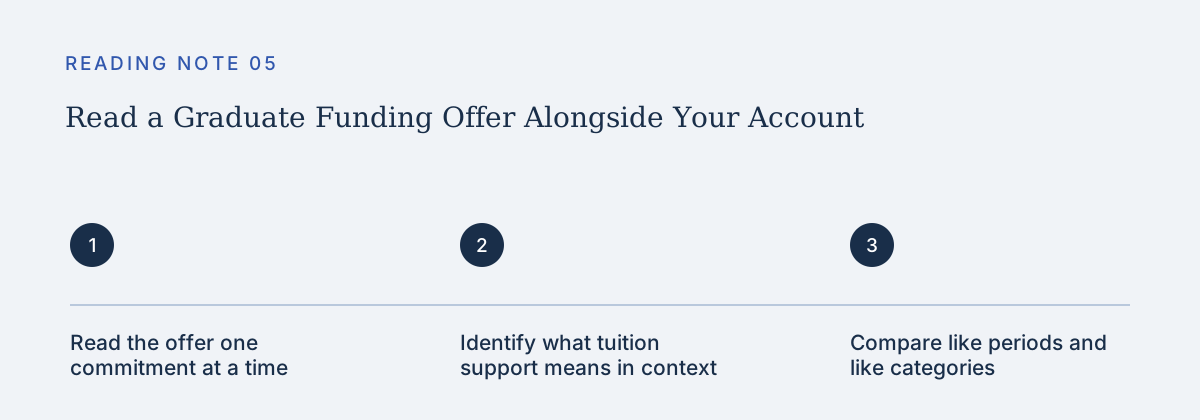
Read the offer one commitment at a time
Start by identifying the provider, the period covered and each type of support described. Separate money paid to you from support intended to reduce educational charges. If the offer uses a broad term such as “funding package,” look for the individual components and their conditions rather than treating the phrase as a precise account description.
Underline wording about eligibility, renewal, satisfactory progress, appointment responsibilities or future availability. A commitment for one period is not automatically a commitment for the next. Likewise, a general statement about typical support should not be silently converted into a personal guarantee. If the language is unclear, ask for a written explanation of the specific point.
Keep the original document and any clarification together. An isolated email sentence can lose context when separated from the term, appointment or condition it addresses. You do not need an elaborate filing system, but you should be able to find the version that applies to the question you are asking now.
Identify what tuition support means in context
The Graduate School's current Tuition Benefit Program guidelines distinguish waived tuition benefits from sponsored tuition benefits and set participation conditions. The program is not a universal promise that every graduate student or every educational expense is covered. Treat the actual benefit type and its eligibility requirements as information to verify with your department.
Ask whether the support described in your offer is part of TBP or a different arrangement. Then ask which term and charges the arrangement is intended to address. Avoid assuming that the appearance of the word “tuition” answers questions about every fee, course or other expense. The responsible office needs the actual arrangement to explain its scope.
A useful clarification is specific: “Which part of this offer should appear as tuition support for this term, and whom should I ask if the entry is missing?” That question does not accuse anyone of an error. It establishes what you should compare and where an unresolved difference belongs.
Compare like periods and like categories
When reviewing an account, make sure the term matches the period covered by the offer or benefit confirmation. A statement covering several periods can obscure what belongs to the current question. Identify the charge or credit by its actual label and date before trying to explain the overall balance.
Do not offset an account charge in your mind using a payment that serves a different purpose. An assistantship payment and a tuition benefit may both support graduate study, but they are not interchangeable account entries. If you need to understand how a particular payment relates to a charge, ask the official office rather than making a private assumption about how the systems will reconcile.
This guide deliberately provides no sample dollar amounts. Invented figures can suggest an expected benefit level or an acceptable balance when neither has been established. The useful exercise is to compare categories, periods and conditions using your own official documents privately.
Ask about a missing benefit without guessing the cause
The TBP FAQ directs a student whose expected tuition benefit credit has not appeared to the home department's tuition benefit coordinator. Begin with the term, the expected support and the relevant written confirmation. Ask whether eligibility and departmental participation information have been verified and what action is required next.
Do not assume every missing credit is simply a posting delay. Nor should you assume that an unexplained charge means the offer has been withdrawn. Both interpretations go beyond the evidence. A narrow question gives the coordinator an opportunity to distinguish an eligibility issue, a missing action or a record that needs further investigation.
While an issue is being reviewed, confirm any current account obligations through the official billing route. This publication cannot authorize you to disregard a deadline, skip a payment or wait for an adjustment. If the timing matters, include that fact in your question instead of relying on an informal expectation that support will eventually arrive.
Revisit changes during the term
The Graduate School's TBP dates page warns that benefits may be reduced or removed if support or other eligibility conditions are not met. A benefit that appeared earlier therefore should not be treated as permanent proof that all future conditions are satisfied. Changes to enrollment, appointments or support deserve a fresh conversation when relevant.
Before making a change, ask the department how it could affect the arrangement described in your offer. Keep academic planning and funding questions connected without assuming that one person can decide every consequence. If several offices are involved, summarize the exact unresolved question for each rather than sending everyone the same broad request.
A fictional summer ambiguity
Imagine a funding letter that clearly describes an academic-year appointment but says little about summer. A fictional student hopes to continue research during that period. The student should ask what support, if any, is separately available and what conditions apply. Continued research activity does not by itself establish a summer appointment or tuition benefit.
The result of that conversation may be a new written offer, a clarification of existing terms or confirmation that no commitment has been made. This example does not predict which answer the university will give. It shows why the period covered belongs near the top of any funding review.
Finish with an explanation you can repeat accurately
A useful review leaves you able to describe who provides each component, what period it covers, which conditions remain relevant and where to ask about a discrepancy. That is more reliable than a single reassuring label such as “fully funded.” Keep the actual commitments intact, and let the responsible university offices resolve the account questions those commitments raise.
Official references and next reading
Tuition Benefit Program Guidelines (official University source)
Tuition Benefit Program Important Dates (official University source)
Tuition Benefit Program FAQ (official University source)