A break from coursework can mean several different things in graduate study. You might be continuing research without taking a familiar classroom course, planning time away from study or trying to finish a final requirement in another term. Calling all of these situations “taking a semester off” hides the details that determine which rules and conversations apply.
This independent guide helps University of Utah graduate students prepare for those conversations. It does not decide whether you should take leave, select a registration option or determine financial, employment or immigration consequences. Describe your actual circumstances to the relevant university offices before making a consequential change.
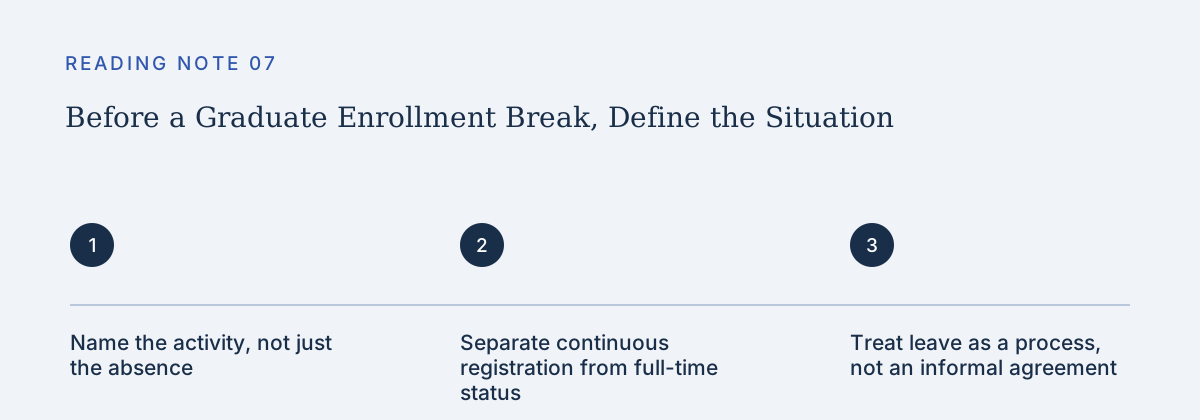
Name the activity, not just the absence
Start by writing what you expect to do during the period. Will you be conducting research, meeting with faculty, using university facilities, taking an examination or defending? Or do you intend to pause study altogether? A plan to stop attending a particular class is not necessarily a plan to stop all graduate activity.
Be equally clear about the period involved. Identify the term or terms and your expected return, if known. You do not need to predict every future detail, but you should distinguish a definite request from an exploratory question. A coordinator can give more useful guidance when the proposed situation is understandable.
Separate continuous registration from full-time status
The Graduate School's registration policy requires continuous registration unless an official leave applies, and it explicitly warns that continuous registration is different from full-time enrollment. Its summer provisions distinguish students not using university facilities from those taking examinations or defending. Consult the current policy for the exact conditions rather than treating summer as automatically exempt.
This distinction is the center of a good question. Ask which academic registration requirement applies to the activity you described. Then separately ask about any funding, appointment or other status requirement that matters to you. Satisfying one purpose should not be assumed to satisfy all the others.
Avoid choosing a course solely because someone says it “keeps you active.” A registration option may have conditions or limitations that do not match your planned work. Ask your department about the appropriate route and the official source for the answer. This article does not prescribe a course number or credit load.
Treat leave as a process, not an informal agreement
The published registration policy describes an official leave process, required approvals and a deadline tied to the current semester. It states that leave is not retroactive. It also distinguishes obtaining leave from formally withdrawing from classes. Review those provisions with your department and the Registrar before assuming a conversation with a supervisor has completed the process.
If your plans are still developing, ask what information is needed and when a decision must be made. That can be a useful first conversation even if you are not ready to submit a request. You should not have to invent certainty in order to learn the available official routes.
If the situation involves health or family circumstances, ask about the appropriate confidential channel for supporting information. Explain enough to route the request, but do not circulate personal medical details widely. This publication does not accept leave documentation or advise on whether a particular reason meets the university's criteria.
Connect the academic change to support questions
A proposed enrollment break may require a separate discussion about an assistantship or tuition support. The TBP guidelines have their own participation requirements. Ask the appropriate coordinator how the proposed academic plan interacts with your actual support arrangement. Do not assume that an approved academic leave also confirms the continuation of pay or a benefit.
International students and students with other status-dependent obligations should also consult the relevant official advisors before changing enrollment. This is a referral to obtain individual guidance, not an immigration or financial determination. The useful habit is to identify every arrangement that depends on enrollment and ask its responsible office about the proposed change.
Keep the questions organized by decision. The department may help identify an academic route; another office may need to explain a separate consequence. Write down what each answer covers so that a reassuring response about one issue is not stretched into an answer about another.
Prepare a return question at the same time
When discussing time away, ask what the return process would involve and which academic plans should be revisited. You may need to consider the timing of a course, committee availability or a research milestone. This is planning, not an assumption that your program will impose a particular condition.
If the expected return date changes, ask how to update the arrangement through the official process. Do not rely on an old plan merely because it was reasonable when first discussed. A short, timely clarification is more useful than discovering later that different people were working from different dates.
A fictional research-only term
Imagine a student who has finished the planned classroom courses and wants to devote the next term to a dissertation. The student initially describes this as “not enrolling because I am only writing.” Before acting, they explain the intended faculty interaction, research activity and defense plans to the department and ask what registration requirements apply.
That discussion is different from a request to pause all study for personal reasons. The fictional example shows why the activity description matters. It does not identify the right course, determine benefit eligibility or imply that every writing term has the same treatment.
Leave with decisions, not assumptions
A useful conversation should clarify the academic route, the steps still required, the applicable timing and the offices that must address other consequences. Keep a private record of the official confirmations. Until a required action is completed, describe it as pending rather than approved. That vocabulary protects your plans from the gap between an intention to take time away and the formal status on which later decisions may depend.
Official references and next reading
Graduate Registration Policies (official University source)
Graduate Credit Policies (official University source)
Tuition Benefit Program Guidelines (official University source)