A program of study is not simply a list of classes you liked, a transcript sorted by date or a forecast of everything you may take. For a graduate student, the important issue is which coursework and other academic work belong to the degree under the applicable requirements and approvals. Preparing a review means making those relationships clear enough for your department and committee to evaluate them.
This article offers an independent preparation method for University of Utah graduate students. It does not determine whether a course counts, approve a substitution or supply a universal credit formula. Begin with the current requirements for your exact program and degree option. Use the official Graduate School pages linked below alongside your department's handbook and advice.
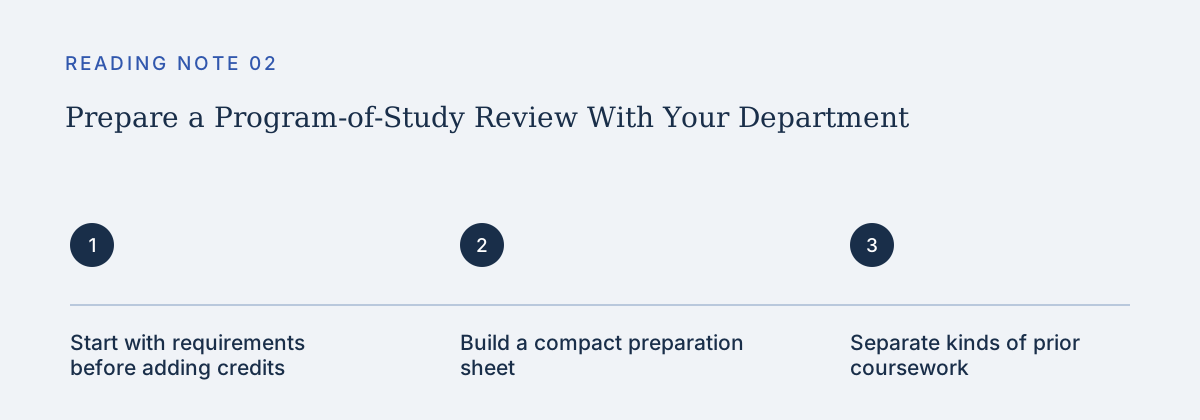
Start with requirements before adding credits
An easy mistake is to total everything completed and compare the number with a minimum. A total can be useful, but it does not establish the distribution, level, approval or suitability of the work. Start by identifying the requirement categories your program uses. Then place each proposed course under the category it is meant to satisfy, keeping uncertain placements visibly uncertain.
The Graduate School's master's requirements state that coursework counted toward the degree needs supervisory committee approval and that departments may require more than the university minimum. The practical lesson is to ask about the role of a course, not only its credit value. A course can be intellectually valuable without filling the particular requirement you had in mind.
For a doctoral plan, avoid importing a master's checklist or treating additional credits as the only measure of progress. Doctoral requirements and program expectations need their own review. Your department can help connect the course plan with research preparation, examinations and the particular route through the degree.
Build a compact preparation sheet
Create a private working document with one row or short entry per course under discussion. Include the course identifier, term, credits, grade if completed and the requirement you believe it addresses. Add the source of that belief, such as a handbook section or a previous written approval. The final column should be a question, not an unsupported declaration of acceptance.
Useful questions include whether the proposed placement is correct, whether an approval is still needed and whether the course is already reflected in the official program of study. This preparation reduces the chance that a meeting gets consumed by identifying which course you mean. It also helps distinguish a planning problem from an entry that simply needs clarification.
Avoid filling the sheet with unrelated personal information. A course-review document does not need your banking details, account password or an entire research archive. Keep copies private and share through the route your department specifies. The document is an aid to discussion, not an official replacement form unless your program explicitly adopts it.
Separate kinds of prior coursework
The Graduate School's credit policy treats transfer work, nonmatriculated work, undergraduate study proposed for graduate credit and approved combined-degree coursework as different categories. Their conditions are not interchangeable. A course taken before admission is therefore not automatically the same kind of credit as a course taken after you entered the graduate program.
Before asking whether an earlier course can count, identify when and where you took it and your student status at the time. Note whether it was used toward another degree. Then ask which policy category applies. That sequence avoids arguing from a broad statement about “graduate-level credit” when the actual issue is how the course was earned and whether the relevant approval conditions are satisfied.
Do not use a friend's successful transfer as a prediction. Their degree, dates, grades or prior enrollment status may differ. Nor should you assume that a course title proves equivalence. If the department requests a syllabus or other academic documentation, provide the version associated with your actual course rather than a newer catalog description that may describe different content.
Make substitutions visible before relying on them
A substitution question should explain both the original requirement and the proposed alternative. Describe the academic reason for the request: the method needed for the research, the overlap in learning objectives or a change in the available course offering. Asking about the process is appropriate even when you do not yet know whether the proposal is likely to be approved.
Keep recommendation and approval distinct. A faculty member may suggest exploring an alternative without establishing that every required decision has been made. Ask your coordinator what documentation is needed and who must review it. Until the answer is confirmed, keep the alternative marked as proposed in your own plan.
This is especially useful when a course is offered infrequently. The planning risk is not simply that you might take the wrong class. It is that you might make several later choices around an assumption that nobody has yet evaluated. An early, specific question gives the department a chance to explain the available routes while there is still time to adjust.
Review the entered plan without rewriting history
The official Graduate Student Summary tutorial describes the program-of-study view as a coursework record and asks students to verify entered information, communicate changes and watch for missing approvals. Use that review to compare the actual record with the plan you have discussed. An unexplained difference is a reason to inquire, not to change your own recollection of what was agreed.
When you find a difference, identify whether the issue is a wrong course, a missing course, an incorrect detail or a missing approval. Those problems may need different responses. A message that says “Please check my program of study” gives less help than one that identifies the disputed item and the earlier communication relevant to it.
A fictional course-choice example
Suppose Elena, a fictional student, took a statistics course while exploring a graduate program and later entered a research master's degree. Her advisor believes the material would support the thesis. Elena still needs to ask how the earlier enrollment status affects the course's possible use and what review is required. Academic relevance alone does not settle its treatment.
Elena brings the course details and asks the coordinator which prior-credit category applies. If the course cannot serve the intended requirement, the next discussion concerns alternatives rather than an attempt to force the record to match her expectation. If it can be considered, she follows the specified approval process and later verifies the result. No outcome is assumed in this example.
Leave the meeting with a usable next version
After a review, revise the working plan to reflect actual decisions. Keep unresolved questions separate and attach a next action to each one: obtain the requested syllabus, ask the committee about a proposed course, or verify a departmental entry after confirmation. Do not preserve contradictory versions without labeling which is current.
The aim is a plan you can explain in ordinary language. You should know which work is accepted, which is planned and which needs a decision. That clarity makes future registration and research conversations more efficient without turning this independent preparation guide into an unofficial degree audit.
Official references and next reading
Graduate Credit Policies (official University source)
Master’s Degree Requirements (official University source)
Graduate Student Summary Tutorial (official University source)
Doctoral Degree Requirements (official University source)