Near the end of a graduate degree, the word “finished” can refer to several moments. You may have completed an analysis, passed a defense, submitted a manuscript or fulfilled the remaining coursework. Each is significant, but none should be casually substituted for confirmation that the degree has been awarded. A careful finish gives each remaining requirement a clear place in the plan.
This independent guide helps University of Utah graduate students prepare a final review. It does not certify graduation eligibility, calculate a completion date or replace advice from your department, Graduate Records or the Registrar. Follow the official requirements for your exact degree and route, particularly if your program uses a project or professional requirement instead of a thesis.
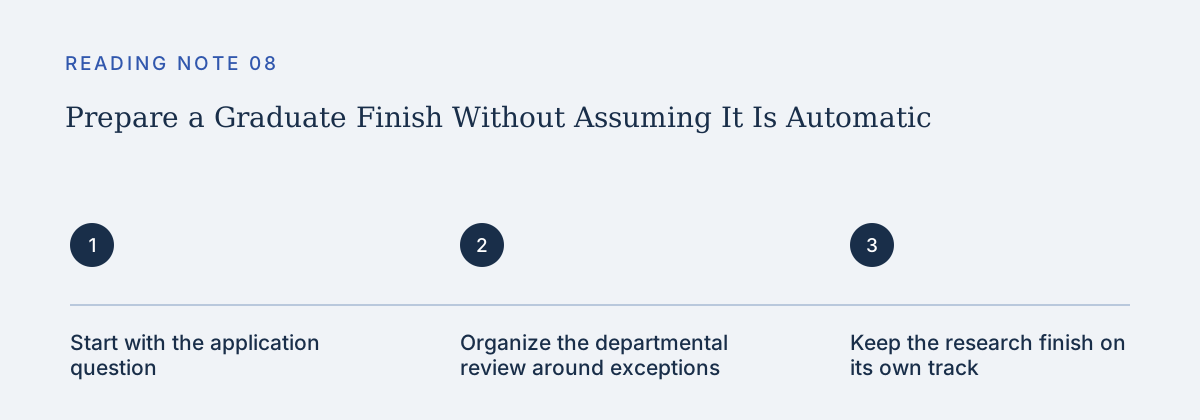
Start with the application question
The Registrar states that graduate students must apply in advance for graduation and should review requirements with an advisor. Its graduate application page explains that the online application depends on supervisory committee information being entered in Graduate School tracking. If the expected application option is unavailable, ask about that dependency rather than treating it as proof of a general login problem.
Keep the application's intended term aligned with the plan you are discussing with your department. If your plans change, follow the Registrar's current instructions for changing or renewing the application. An earlier submission should not be assumed to update itself after a research schedule shifts.
The application is a declaration of intent through an official process, not an assurance that all academic requirements are complete. Keep its confirmation, but continue the separate review of coursework, approvals and any final research requirements. That distinction prevents the understandable relief of applying from becoming a reason to stop checking.
Organize the departmental review around exceptions
Instead of asking for a general reassurance, identify anything that is not yet straightforward. A course may have an unresolved grade, a substitution may need confirmation or a required approval may still be missing. Ask your department which of these matters remains open and what evidence will establish completion.
The Registrar's graduate checklist specifically calls for attention to incomplete grades, exceptions and finalized coursework or approvals in the graduate summary. Use it as a reference for your review, not as a reason to infer the correct treatment of a particular grade yourself. The relevant instructor or department needs to address the actual record.
A short agenda can prevent the final review from becoming overwhelming. Put the potentially consequential issues first, then routine confirmations. If one issue depends on another, make that relationship explicit. You do not need a perfect private spreadsheet; you need a shared understanding of what could still prevent the intended outcome.
Keep the research finish on its own track
For a thesis or dissertation route, compare your manuscript stage with the official Thesis Office process and calendar. A successful defense, submitted manuscript and final release refer to different stages. Ask about the stage that is actually pending rather than saying only that your thesis is done.
For a non-thesis or project route, ask the department what final work and recording steps apply. Do not import the manuscript process just because other graduate students discuss it frequently. A useful checklist follows your degree requirements, not the most visible graduate experience on campus.
If a deadline is approaching while a dependency remains uncertain, tell the responsible office exactly what is outstanding. A general plea to “make graduation happen” gives less actionable information than a precise account of an unresolved approval or requirement. No independent guide can promise an exception or expedited processing.
Ask what a confirmation actually confirms
Read official messages carefully and preserve their scope. A department may confirm completion of a requirement, the Thesis Office may confirm a manuscript stage and the Registrar may address the graduation application or degree record. These messages can all be positive while referring to different outcomes.
The Registrar's checklist distinguishes completion of requirements from the later award of the degree at the end of the term. If an employer or another school needs evidence before the degree is posted, consult the official guidance about available documentation. Do not issue your own declaration that the university has already awarded the degree.
When communicating an expected finish to others, use language that matches the evidence. “I expect to complete the remaining requirements this term” is different from “My degree has been awarded.” Keeping those statements accurate protects both your plans and the expectations of people relying on them.
A fictional final-term disagreement
Suppose a student believes a course substitution was approved, but the final review still shows the original requirement as unresolved. The student locates the relevant departmental communication and asks which part of the process remains incomplete. They do not assume the course must be taken again, nor do they insist that an informal recollection settles the official record.
The resulting answer may clarify the existing approval, identify a missing action or explain that further review is needed. This is a fictional example with no promised outcome. Its value is the specific question: what remains between the documented academic decision and the requirement's recorded completion?
Plan the handoff after the last academic task
Before you leave campus or move into another commitment, know how you will receive official updates and follow up on unresolved matters. Keep the relevant confirmations accessible in a private location. You may feel ready to put the degree behind you, but a clear record of the remaining administrative steps can reduce unnecessary uncertainty later.
Do not confuse participation in a celebration with the status of the degree. Enjoy the milestone while continuing to rely on official confirmation for statements about completion and award. The final plan should make room for both the human significance of finishing and the precise academic record others may need.
A deliberate graduate finish is not a demand to worry about everything. It is a focused review of the application, the remaining requirements and the evidence of completion. When those pieces are understood, you can celebrate progress without asking a single screen, email or ceremony to prove more than it actually does.
Official references and next reading
Apply for Graduate Degree (official University source)
Checklist for Graduate Applicants (official University source)
Master’s Candidates: Graduation Overview (official University source)
Doctoral Candidates: Graduation Overview (official University source)
Thesis Office Calendar (official University source)