The names of faculty members who advise you informally may not be identical to the names on your formal supervisory committee. Both relationships can matter, but they answer different questions. When a committee needs to be formed, reviewed or changed, begin by separating intellectual collaboration from the approved structure required for your particular graduate degree.
This independent article helps you prepare that conversation at the University of Utah. It cannot approve a committee member, interpret an individual's faculty status or determine whether an exception applies. The current Graduate School requirements and your department's process control those decisions. Avoid relying on an old form or a different program's website merely because it appears in search results.
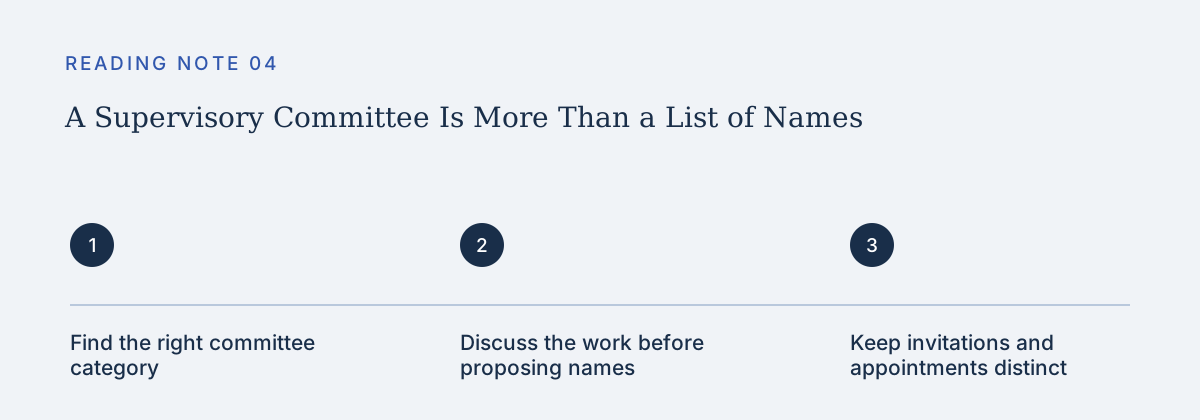
Find the right committee category
Current university guidance does not support one committee-size rule for every graduate student. For thesis-based master's degrees, the Graduate School describes a three-faculty-member committee unless otherwise approved. For non-thesis master's degrees, it describes a minimum of one qualified member, with additional members at departmental discretion. Chair and membership conditions also matter, so a head count alone is not enough.
Doctoral thesis or dissertation committees generally have five members under the published guidance, with specified composition requirements and possible approved program-level variations. Professional or project-based doctoral degrees have distinct provisions. These are reasons to ask which rule applies to your exact degree, not invitations to select the smallest committee that appears anywhere on the website.
Ask your graduate coordinator where the current program expectations are documented. If a departmental page and a university page seem inconsistent, identify the exact difference and request clarification. The difference may concern a degree option, a program-specific rule or an outdated document. This guide cannot resolve it by assuming either page is universally applicable.
Discuss the work before proposing names
Before collecting names, describe the scholarly work the committee will need to evaluate. What methods, subject expertise or professional perspectives are central? What kind of feedback would help you move from the current project to a defensible final product? These questions make the conversation about academic fit rather than just administrative completeness.
Your chair or program can help you consider appropriate people and the formal conditions for service. Do not infer eligibility from a title on a faculty webpage alone. An external collaborator may bring valuable expertise while still requiring a particular approval route. Similarly, a faculty member's willingness to discuss research is not proof that the committee appointment has been finalized.
Keep invitations and appointments distinct
When a prospective member agrees to serve, ask your department what happens next. There may be information or documentation you need to provide through an official process. Keep your own language accurate: “has agreed to be proposed” and “appears on the approved committee record” communicate different stages.
A short private checklist can identify the proposed role, the department's requested action and the unresolved question. It should not become a public directory of personal contact information or an unofficial certification of eligibility. Use official university communications for the appointment process, and never send credentials or student records to this publication.
Handle changes before they collide with a milestone
Committee changes can arise for ordinary reasons: research focus evolves, a faculty member's availability changes or a program recommends a different configuration. The important planning question is how the proposed change affects the next academic decision. Ask before assuming a new member can participate in a milestone under the old record.
Describe what is changing and why it matters now. For example, a change before a proposal review may raise different practical questions from a change near the final defense. Ask whether pending approvals, scheduled meetings or manuscript signoff need attention. Do not assume that a calendar invitation or an informal agreement updates the formal committee information.
Keep the conversation respectful and factual. A request to clarify committee procedure does not require a detailed public account of interpersonal difficulties. If the change involves a sensitive situation, ask the appropriate departmental contact about a private route to discuss it. Share the information needed for the decision without distributing unnecessary personal details.
Compare the record after confirmation
The Graduate Student Summary tutorial tells students to verify committee information and keep their department informed about changes. Once your department confirms the relevant action, review what the official record shows. If something differs, identify the specific member or role rather than reporting that the whole committee is wrong.
Ask what further step is needed if the record does not reflect the confirmed decision. Avoid inventing a normal processing time or assuming that a delay means rejection. A well-formed question includes the date of the department's confirmation and the part of the record that still needs explanation.
A fictional outside-member question
Suppose a student wants a researcher at another institution to join a doctoral committee. The researcher has relevant expertise and is enthusiastic. The student first asks the coordinator which outside-member provisions and supporting documentation apply. They do not treat enthusiasm, reputation or a collaborator's university email address as a substitute for the required review.
The student also asks how the proposed role relates to the rest of the committee's composition. That is a better question than asking only whether “outside people are allowed.” The hypothetical example illustrates preparation, not an assurance that any particular researcher qualifies or that approval will be granted.
What a completed conversation should establish
At the end of the discussion, you should understand the applicable committee category, which names and roles are proposed or confirmed, what action remains and how to verify the result. If any of those points are unresolved, keep them explicit. A committee is a scholarly relationship with formal responsibilities, and good preparation respects both sides of that relationship.
Official references and next reading
Master’s Degree Requirements (official University source)
Doctoral Degree Requirements (official University source)
Graduate Student Summary Tutorial (official University source)